
PLUS Change in Depth: Intervention points to unlock more just and sustainable land use decision-making
While policies set bold climate and biodiversity targets that include land use transformation, the change remains limited without effective ways to intervene in decision-making systems.
Article by Simon Vaňo of CzechGlobe.
Check out our previous blog post, Political Economies of land use change – Lessons from across Europe
In PLUS Change project we have analysed political economies, addressing an interplay between policies and actors across twelve diverse Practice Cases, from which we identified four intervention points for land use decision-making and policy change. These intervention points act as levers that can shift how decisions are made and implemented, helping to overcome barriers and seize opportunities for change.
The first intervention point lies in enhancing multi-actor participation, equity, and decentralisation in decision-making. In most of the twelve Practice Cases, decisions are dominated by central or regional governments, while local voices, citizens, and smaller actors remain marginalised. Expanding the participatory spaces, and ensuring that underrepresented groups are heard, strengthens the legitimacy and effectiveness of land-use decisions. For example, Zaanstreek-Waterland and Nitra City promote such approaches where citizens and NGOs are more actively engaged, contributing with ideas for future land use and urban transformation, or to solve housing issues.
The second intervention point focuses on bridging policy gaps and fostering integration across sectors and scales. Many Practice Cases reveal fragmented and weakly coordinated policies, which may lead to tensions between policy interests and negatively affect land allocation. Cross-sectoral and cross-scale integration could align the policies and allow for more coherent approaches. The Three Countries Park illustrates the potential of integration by coordinating across national borders, where local governments and stakeholders are building joint strategies for landscape management that overcome administrative boundaries.
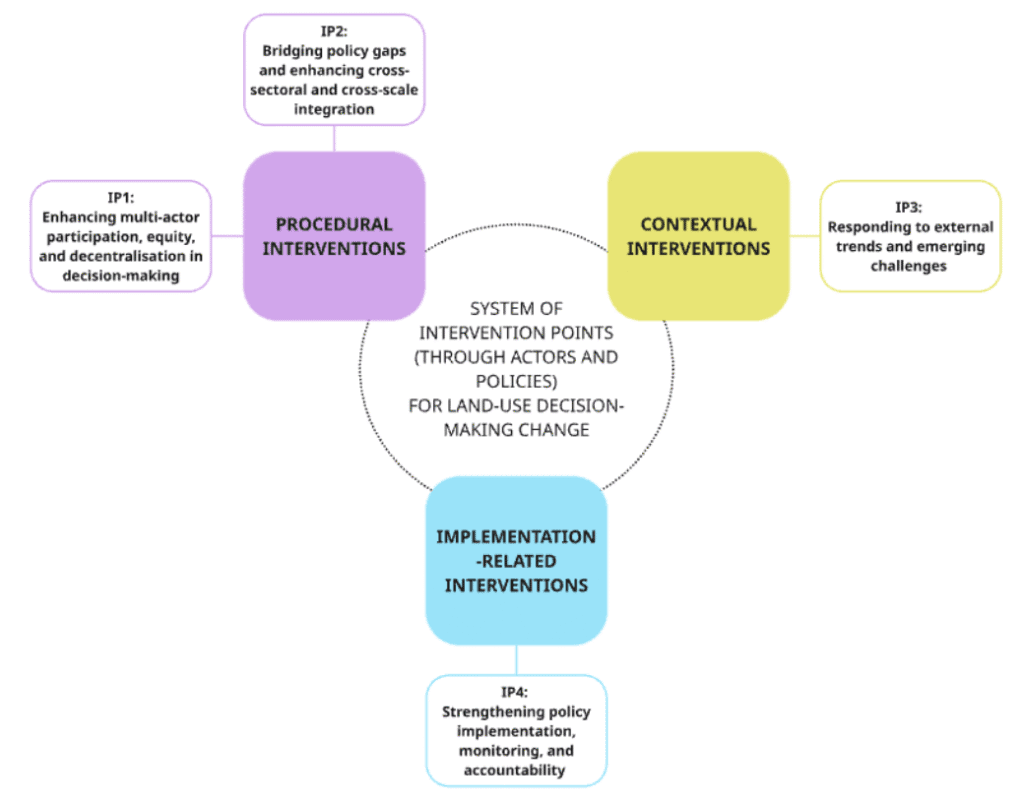
The third intervention points address external trends and emerging challenges. This intervention reflects that land use is increasingly shaped by global and regional drivers such as climate change, energy transitions, and demographic shifts. Intervention here means designing flexible and adaptive policies that can respond to such dynamics while safeguarding local priorities and ensuring just transitions. To illustrate this, policies in South Moravia aim to balance food production with renewable energy infrastructure, and Surrey focuses on housing policy to meet the growing demand while at the same time promoting sustainable urban development.
The fourth intervention is represented by strengthening the implementation, monitoring, and accountability. While many policies across the Practice Cases are visionary and ambitious, their translation into practice is often weak due to underdeveloped monitoring mechanisms and indicators, impeding the policy enforcement and progress tracking. This creates a gap between intention and reality. Strengthening accountability mechanisms through independent oversight, transparent evaluation, and clearly assigned responsibilities, would help in ensuring that policies do not remain on paper but translate into real change.
Taken together, these intervention points represent a palette of options. Different contexts require different levers, meaning that what would work in Amsterdam’s dense metropolitan setting may not apply directly to Parc Ela’s natural, scarcely populated landscapes. Yet the principle remains the same. By identifying where the specific case (system) is most open to change, and to what degree, we can start applying these levers in context-specific ways to unlock paths toward more just, inclusive, and sustainable land use. We suggest these intervention points provide a strong starting point for action that could reconcile climate resilience, biodiversity conservation, and social well-being.
Learn more in Deliverable 4.1, Intervention points for creating land use policy and decision-making change!
Banner photo by Nick Night on Unsplash.